


.svg)
February 15, 2026
Why Getting a 3D X-Ray in Las Vegas, Actually Makes Your Dental Visits Easier
Advanced 3D dental X-rays provide clearer diagnosis, safer treatment planning, and faster, more comfortable imaging for complex cases.
February 15, 2026
Advanced 3D dental X-rays provide clearer diagnosis, safer treatment planning, and faster, more comfortable imaging for complex cases.
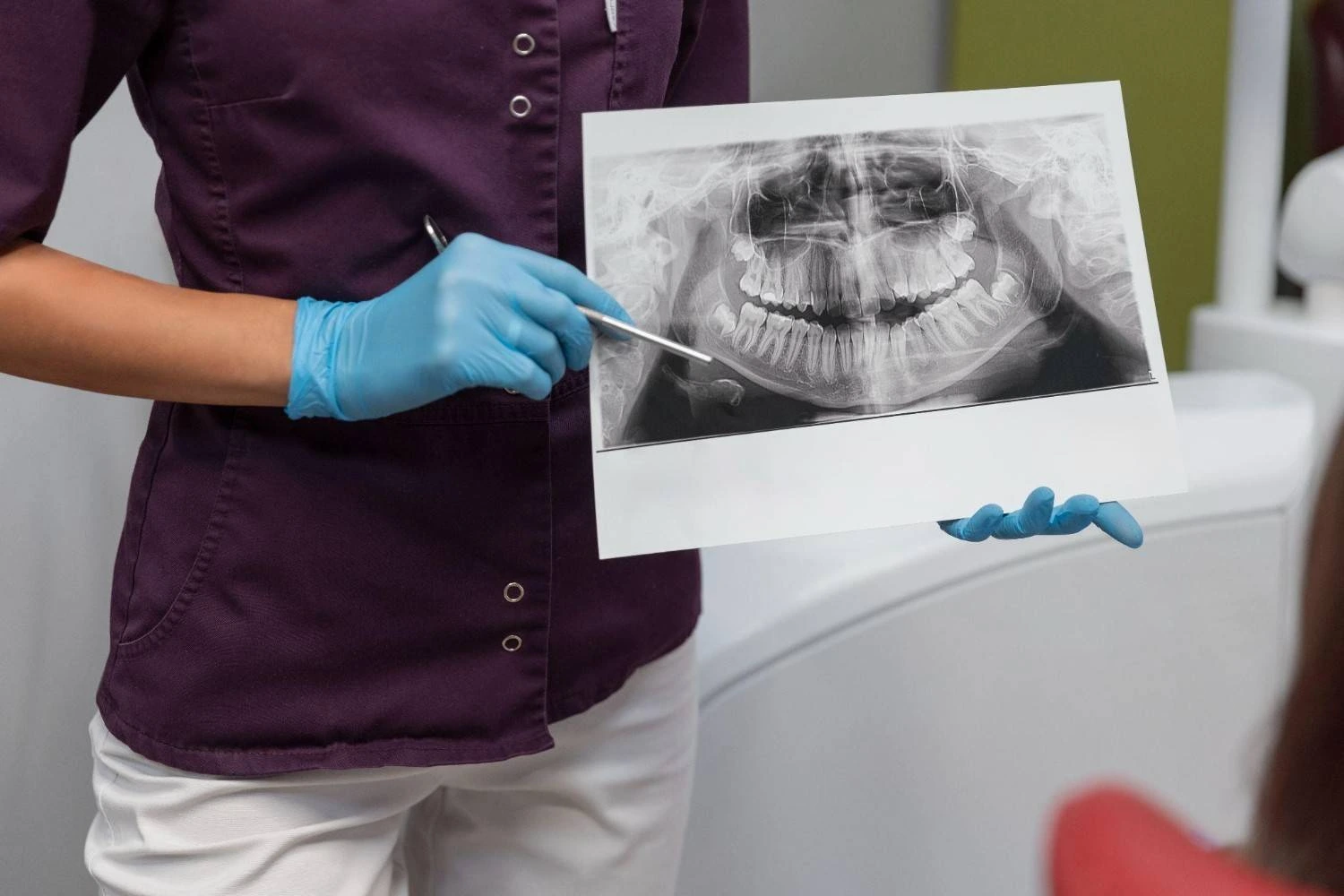
You know that feeling when the dentist near youstudies a regular X-ray, tilts their head, and murmurs something like, “I seesomething off, but it’s hard to tell exactly”? It leaves everyone a littleuncertain. Frustrating for you. Challenging for them, too.
That’s one big reason 3D X-rays in Las Vegas, NV, have become so muchmore common in dental practices lately. These aren’t simply upgraded versionsof the usual films. They capture far more information in a single pass, revealingdetails that flat images often miss. Small issues get spotted sooner, beforethey grow into something that demands more involved fixes.
Standard dental X-rays deliver a flat, two-dimensionalsnapshot. Useful for everyday checks like spotting obvious decay or checkingbone levels around teeth. But when the view needs depth—say, the precise curveof your jawbone, the path of a nerve, or how a tooth sits in relation toeverything else—those flat pictures reach their limit fast.
3DX-ray near you (often called cone beam CT or CBCT) takes a differentapproach. The machine rotates once around your head, gathering images fromhundreds of angles in under a minute. Software then builds a fullthree-dimensional model you can rotate and slice through on a screen. It’s thedifference between glancing at a photo and actually holding the object, turningit to see every side and hidden spot.
Routine exams and basic cavity checks still rely on standardX-rays just fine. But certain situations make the extra detail invaluable.
● For dental implants. Dental implants top thelist. Success depends on knowing bone thickness, density, and exact nervelocations. A 3D X-ray maps all that clearly, so placement happens at the idealangle and depth. Fewer adjustments mid-procedure. Lower chance ofcomplications.
● For tricky root canals. Some teeth have unusualroot shapes or extra canals that generally don't show up well on flat X-rays. A3D view helps your dentist see the full layout before starting treatment. Thisreduces the chance of missed areas that could lead to infection later.
● For impacted teeth. Impacted wisdom teeth orother buried ones need careful assessment. 3D X-ray reveals their position nextto nerves, sinuses, or adjacent roots—information that helps plan a safer, morestraightforward removal.
● For TMJ issues. Even jaw discomfort fromtemporomandibular joint disorders gets clearer answers. The joint’s structureis intricate. Misalignment, wear, or early arthritis can hide in flat images.Three-dimensional views make those issues easier to identify and address.
Here's what 3D X-ray near you does better than traditional methods:
● They catch things earlier. Hidden cysts, slowbone changes, low-grade infections, or small abnormalities often appear firston a 3D scan. Catching them before pain or swelling starts usually meanssimpler, less expensive treatment.
● They make treatment more predictable. Withprecise measurements and detailed visuals, planning becomes more predictable.That means fewer complications, shorter procedures, and better overall results.Implant and orthodontic setups align better. Surgical extractions are lessuncertain.
● They use less radiation than you'd think. Awidespread misconception holds that these scans blast you with high doses. Inreality, focused cone-beam technology keeps exposure much lower than amedical-grade CT scan (frequently around 100 microsieverts versus dosesexceeding 500 for a full-body CT). It’s typically only modestly higher than afull set of standard dental X-rays, yet delivers vastly more useful data in onequick session.
● They're fast and painless. The process itselfstays comfortable. You stand or sit upright. The arm circles smoothly, with nolying enclosed and no biting awkward film holders for long stretches needed.Most people finish before they realize how fast it went.
Modern machines follow strict protocols to use the lowesteffective dose while still producing sharp images. Dentists weigh thediagnostic gain against any minimal risk every time. Scans happen only whenthey add meaningful value, and are not routinely overused.
Comfort-wise, patients frequently comment on howstraightforward it feels. No tight spaces. No lingering discomfort. Just abrief, open rotation.
A dentist in Las Vegas will suggest one only if your situation calls forit—perhaps upcoming implants, persistent jaw symptoms, or unclear root-canalanatomy. For general cleanings and checks, standard imaging remains plentyeffective.
Advanced imaging, like 3D X-ray in Las Vegas, NV, quietly removes a layerof uncertainty from tougher cases. That clarity leads to better decisions,smoother treatments, and—ultimately—healthier outcomes with less stress alongthe way.
If a dental concern has been lingering or you’re preparingfor a complex procedure, Complete Dental is ready to help. Our teamrelies on up-to-date tools to deliver precise diagnoses and thoughtful careplans. Give us a call today to book with a reliable dentist near you. We’d be glad to assist.

We proudly serve patients throughout Las Vegas, including Spring Valley, Summerlin South, West Sahara, Charleston, The Lakes, Winchester, and Downtown South, as well as surrounding LV neighborhoods.
.webp)
.svg)
2625 S Rainbow Blvd D-100
Las Vegas, NV 89146
Monday: 9 am - 6 pm
Tuesday: 9 am - 6 pm
Wednesday: Closed
Thursday: 9 am - 6 pm
Friday: Closed
Saturday: Closed
Sunday: Closed
3167 E. Warm Springs RD #200
Las Vegas, Nevada 89120
New office is open in August 2026.
Monday: Closed
Tuesday: Closed
Wednesday: 9 am - 6 pm
Thursday: Closed
Friday: 9 am - 5 pm
Saturday: 9 am - 1 pm
Sunday: Closed
.svg)

.svg)


.avif)
.avif)
.avif)
.avif)